Second of a five-part series
Denise and I married, and I began a six-year grad school journey at a St. Paul, Minnesota seminary that included a two-year internship in Perú, South America. I didn’t play much golf while in seminary, and during the two years we lived south of the equator I never touched a club.
“How Ya’ Doin’, Rev!”
In January 1991, we moved to Texas where I began to work as a pastor at a church on Houston’s west side. Shortly thereafter, our son Mitch was born, joining his older sisters Lauren and Alex. A new city, a new job, and three young kids—at best I played once a month. My game wasn’t that good. I rarely broke 80. I typically played with older guys at my church, and at their prodding, I moved up to play the white tees with them. I swear it made my game worse. Memories of good rounds while in college, rather than inspiring me, haunted me. I knew I could play better, but I never did.
Friends and relatives up north would ask me how my game was. I’d tell them that, for me, living in Texas meant that I could play mediocre golf all twelve months of the year. Then two things happened to make my lucky golf stars realign: We moved to Austin and our son Mitch aged into kindergarten.
Parish pastors typically take one day off during the week. My day off was Thursday, and with Mitch in all-day kindergarten, I suddenly had a free day to myself. I made another great decision. I dedicated Thursdays to teeing it up. And Austin had four decent public golf courses by which to do so. My old Wilson Staff blades, now about twenty years old, started firing good shots again. Eventually, I started breaking 80 again.
A couple of years in, I bought monthly passes to the Austin city courses. (A few years after that, Austin Parks and Recreation would offer a yearly pass, which I jumped on.) The monthly pass was a bit more than the $60 summer pass of my youth, but it was a good deal nonetheless. Austin, a great golf town, generously supports its city courses through its parks and rec budget. I was playing the back tees again. I started keeping my handicap again, which fluctuated between 3 and 5, the same as it was in my college days. I got to know some of the good amateurs around town.
I started playing tournaments again, with a special focus on the Austin Men’s City Championship, competed the first weekend in August. An amateur tournament, past champs include three players who would later win as pros on the PGA tour: two-time Masters champ Ben Crenshaw, J. L. Lewis, and Wes Short Jr. I first competed in Men’s City in 1999, two years after we had moved to Austin. My first tournament in fifteen years began with a qualifier at Lions Municipal. Shoot 81 or better, and you’re in. Then it was a three-day event with a cut after each of the first two rounds. After clearing the qualifier hurdle, I had a rough first day and shot 87 at Morris Williams, almost securing last place, and definitely deserving an unceremonious MC—missed cut. No worries. I had a golf challenge to take on and I was more than happy to do so. More on Men’s City later.
I became a regular at the city’s southeast dual golf course complex, Jimmy Clay and Roy Kizer, hereby referred to as the “CK.” I got to know one of the ever-present pros behind the check-in counter, Jack Marr. Jack had a commanding gravel voice, knew every good player in town (and vice versa), and could hold his own in conversations that delved into philosophy and theology.
Jack was the younger brother of 1965 PGA Champ and longtime ABC golf analyst Dave Marr. Consequently, Jack knew Arnie, Nicklaus and Trevino, and a bunch of others. And Jack had stories.
When Jack found out my vocation, he immediately dubbed me “The Rev.” I loved walking into the pro shop and hearing Jack belt out, “How ya’ doin’, Rev!” When Jack Marr gave you a nickname, it stuck. And now more than twenty-five years later, that’s still the case.
Jack’s obit is linked here—it’s well worth the read. It’s a treat, just like knowing Jack was.
No matter one’s job, profession, or vocation, having another community to call one’s own can be a monumental blessing. That has been and is certainly the case for me. I cherish the community that I share with my colleague pastors—consisting of fellow Lutheran clergy and a few others across denominational lines—and wouldn’t have made it this far without them. But having another go-to community and a long-time cabal of guys that I’ve played with regularly—that’s unbeatable.

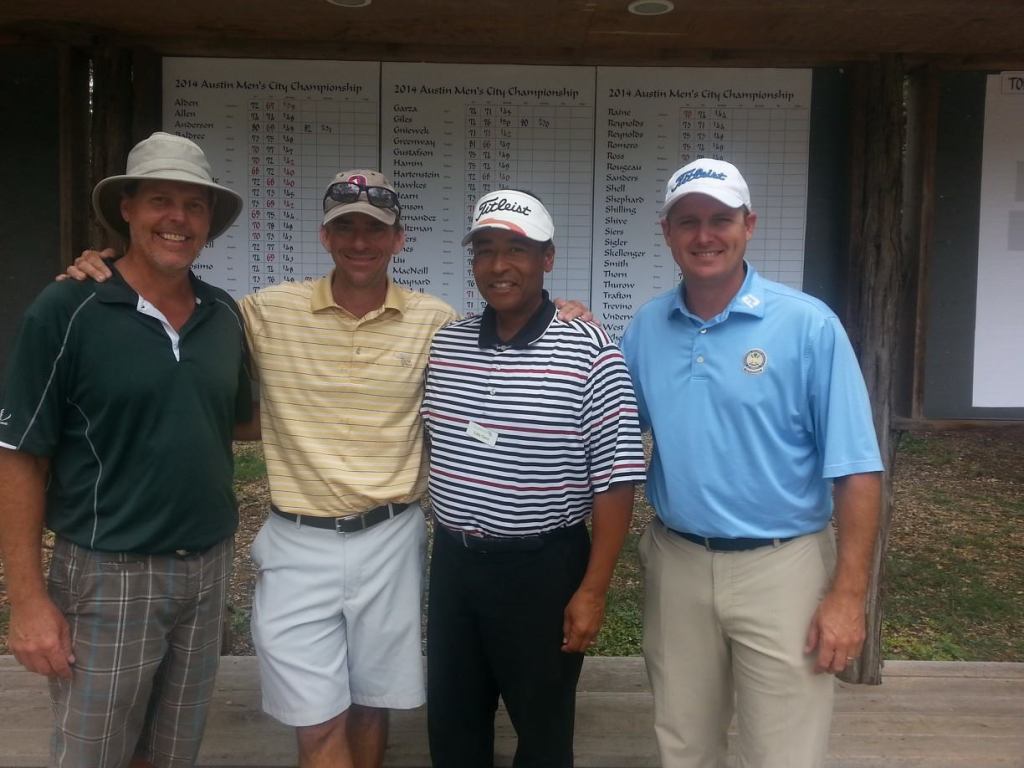
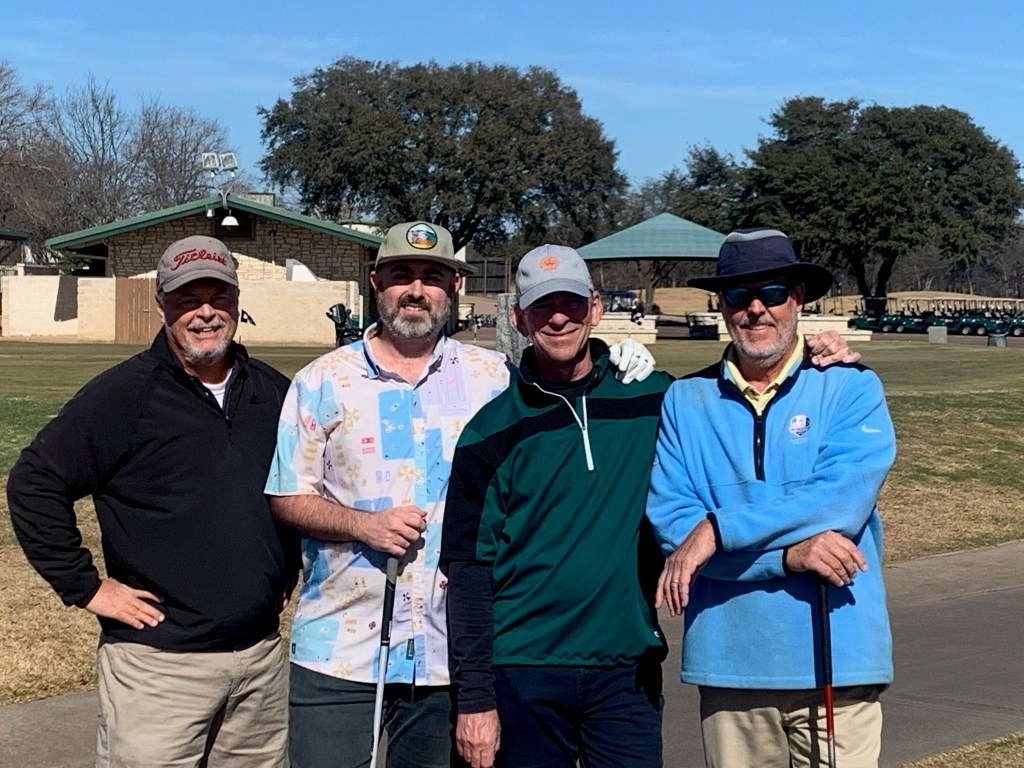
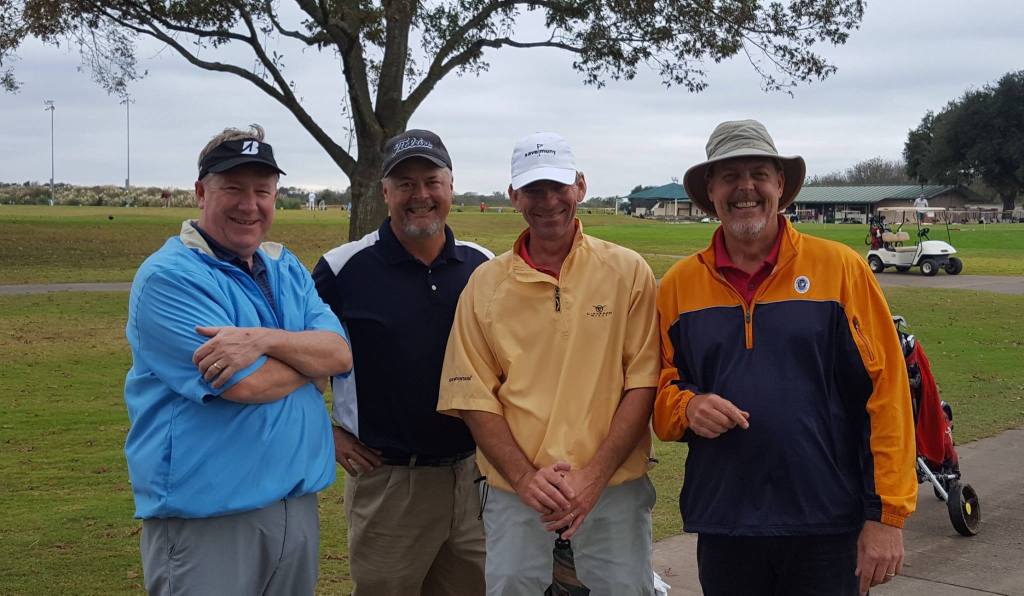
It’s like the line out of the “Theme for Cheers”: “Sometimes you wanna go / Where everyone knows your name / And they’re always glad you came.” Being part of the golf community in and around the CK has been life-giving: instructive for golf, and didactic for life.
Especially at a public golf course, you can meet all sorts of different folks. I once played 18 holes at Kizer with a guy who, as I found out toward the end of our round, was in an entirely different line of work than mine. The guys in the pro shop who set us up to play together knew what was going on, but they didn’t let either of us in on their secret. As the two of us strolled up the 18th fairway together, he asked me what kind of work I did. I told him, and then I asked him what he did. He told me: He was the general manager of a North Austin strip club.
Here’s the deal: We were honest with each other because we had made a connection over the four hours it typically takes to play a round of golf. He easily could have told me something else—“I manage a restaurant”—after hearing that I was a minister. And there’s plenty of people in my profession who have abused others—in horrendous fashion—so I can’t make the judgment that he was ipso facto a bad dude because of his profession.
A public golf course is one of the few places in this day and age where you can make honest connections with complete strangers. You and a playing partner might discover you share some commonalities. These types of connections, even if only in play for a few hours, build community. In our hyperpartisan-divided society, community building is a bit of a lost art. (Honest connections can happen at private golf courses as well, but those connections are on a restricted basis as private courses, by definition, are closed communities.)
The game of golf has a culture shaped by rules and etiquette, and part of that culture includes being socially agreeable with and to your playing partners. There are specific do’s and don’t’s. Announcing your religion or politics to your playing partners who you just met on the first tee? That’s not acceptable on the golf course. Those conversations, if desired, can happen after the round at the fabled 19th hole.
The next time I came into the clubhouse to check in for a round, the guy who set up the minister and the strip club manager to play together, asked me, “How’d that round go the other day, Rev?”
By his smile, I knew that he knew. I smiled back and told him it went just fine. A golf course, we both agreed, was one of the few settings where a meeting like that could occur.
“Why Don’t You Come and See Me for a Lesson?”
So, there lie my ball on the hardpan on the left portion of the mini-pecan grove on the right side of Jimmy Clay’s #18, the difficult, long closing par-4. I had a window, however, through the trees to the green. I was about 200 yards out, and the play was a low, controlled cut 3-iron, that would roll up on the green. I gripped my Wilson Staff blade, took it back slowly and came through hard with the face slightly open. Upon contact, I immediately sensed something awry. The ball squirted weakly to the right and I saw, to my horror, that the clubhead had twisted. I was stunned to see a gaping metal wound on the hosel of my beloved 3-iron with which I had hit a number of great shots over the years.
Wow. That was a quick and unexpected demise. But my Staffs were more than twenty years old. It was time to replace them.
I eventually settled on Cleveland TA3s, 3-iron through PW. Beautiful sticks, and I got them off the used rack in great shape at the Golfsmith mothership shop in Austin. To boot, I liked their moniker “TA.” By this point, at close to 40 years of age, I had accepted the fact that cavity-back clubs—aka, game improvement clubs—could help my game.
Within four years, however, there I was at Golfsmith again looking at new clubs. My game was stalled at 3-handicap. A lot of guys would kill to have an index of 3, but I knew I could get better. It was a cold and rainy January day, so I asked one of the Golfsmith guys to tape up some new Hogan irons for me. Golfsmith had indoor nets and a hitting screen that gave shot feedback, so I started swinging away. I told the employee that I had Cleveland TA3s, but I was looking for something different to help improve my game. I told him I had played golf in high school and college, but all these years later, I was stuck. I took some 15–20 swings and told the Golfsmith guy that I wasn’t sure about the Hogan irons. He looked at me as he reached in his pocket, producing a business card. As he gave me the card, he said, “Instead of spending $800 on new irons, why don’t you come and see me for a lesson?”
How’s that for a proposition?
Mike Marak was his name and I called him the next week for my first golf lesson ever from a teaching pro. I never had a dedicated lesson before, and truth be told, I was thinking it was time to do so. Mike’s timing was exquisite.
I met him at the same Golfsmith facility, and by late January, the weather had improved to the point where we had the lesson outside at the driving range. Mike told me that my Cleveland irons were great clubs—I needed to, he said, make some changes in my set-up and swing. He had me do three things: 1) strengthen my left-grip hand, 2) stand up straighter at address and closer to the ball, and, 3) start my downswing, not with my hands, but with my feet and legs.
Pretty simple stuff, right? After 45 minutes or so, Mike left me with a large bucket of balls and the “three things” homework. I stayed at the range and continued to work on the three things. I completely lost track of time. I was supposed to pick up Mitch from basketball practice at middle school, but by the time I checked the time on my phone, I realized I wasn’t going to make it from North Austin to South Austin in time. I called Denise and asked if she could cover for me. I owed her one.
I saw Mike two other times that spring. To help me stand up straighter at address, I regripped my TA3s and inserted a half-inch extender. I started hitting a draw with the stronger grip, and as Mike promised at my first lesson, I gained an extra club of distance with the same irons. That October of the same year, 2005, I made it officially to my goal—0.0 GHIN handicap, aka “scratch.” The clinching round was a 73 at Jimmy Clay on the last Thursday of September. My average score that fall was 74 and a bit of change.
I shot Mike a text to let him know I had reached my goal. I included a big huge “THANKS!”
I’m not the first golfer Mike Marak has helped out significantly, and I won’t be the last. He left Golfsmith, shortly after I started seeing him, to solely give lessons. I’ve seen Mike probably twenty times since that first lesson. It’s always good to get a check-up to make sure you’re still making the right moves. Mike’s book, Relax: It’s Only Golf, is on my shelf and chock-full of good golf-swing wisdom and great drills.
Austin Men’s City Championship, Part 1
Some good golfers don’t like to compete in tournaments. I can understand—there’s an added layer of pressure because every single stroke counts, including the flawed ones. The tournament setting in my estimation, however, is the true test of your game. Playing tournaments in high school and college set that stage for me. Over the years in Austin, I’ve played in the Firecracker, the Bluebonnet Cup, the Spring Mid-Amateur, Men’s City, Men’s City Senior, and a few others.
After the 87 and missed cut at Men’s City in 1999, I verified that result the next year by shooting a low-80s number and missed the first cut again. By 2001, I managed to make the first cut and play into the second day of Men’s City—progress. I had garnered a boost of confidence the month prior when I busted 70 for the first time ever. We had gathered in the Chicago area to celebrate my parents’ 40th wedding anniversary, and we had a golf outing to an easy track. The par 70, Brae Loch G. C. in Grayslake measures all of 5875 yards, and has a 69.6/115 rating and slope. I birdied three of the last four holes to shoot 68. It was a huge confidence boost to break on through to the other side for the first time.
But to no avail . . . I missed the second cut in Men’s City in 2001. And again in 2002, 2003 and 2004.
I just couldn’t make it to the final and third round of Austin’s city championship. One of those years, I remember 3-putting from tap-in distance on the first hole of the second day on Jimmy Clay. Of course, I was nervous—it was Men’s City. A playing partner audibly groaned when I missed my second tap-in. No golfer wants to see that, because it could be contagious. At that point in time, I didn’t have the game—or the confidence—to overcome an opening triple bogey and keep it in mid-70s, which is what I needed to make the second cut that day.
It was one of the reasons I took Mike Marak up on his proposal to come and see him for a lesson in 2005. After the three lessons with Mike, my game was trending in the right direction. My handicap at the outset of Men’s City that August was 0.9, my lowest ever. I was ready to go, and why not go low?
I opened with a disappointing 78 at Morris Williams—at least it was inside the first cut line of 80. I wasn’t overly worried, because I’d be playing my second round at Lions Municipal, aka Muny. I figured I could go low at Muny, a short track with intriguing greens where almost every putt breaks south toward the Colorado River.
Well, after lipping-out my second putt on #18 for an eventual three-whack bogey, I managed to tour Muny that second day in 80 big strokes. I garnered yet another MC by a whopping six strokes.
Damn.
Click here for “My Golf Story, Part III”
T. Carlos “Tim” Anderson – I’m a Protestant minister and Director of Austin City Lutherans (ACL), an organization of partners in Austin, Texas working together to serve low-income individuals and families.
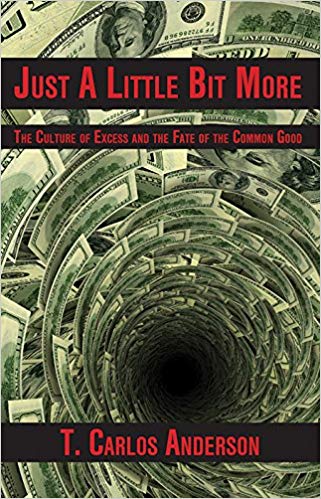

Check out any of my books – Just a Little Bit More (2014), There is a Balm in Huntsville (2019), and There is a Balm in Wichita Falls (2024).

 T. Carlos Anderson