The third part of a five-part series
Austin Men’s City Championship, Part 2
Back in my parish pastor days, I’d have four vacation Sundays per year. I used one of those to play in Men’s City each year. But as you’ve read to this point, I’d never made the final cut for the last round, played on Sunday. And when you ask a fellow pastor to sub for you, you don’t call them at the last minute—for example, after missing the cut on Saturday—and tell them that their services aren’t needed. They’ve prepared a sermon to deliver, and the guy who missed the cut hasn’t prepared one.
After missing the cut in 2005, I was flummoxed. Golf, as we know, can do that to you. So, I decided to play again on Sunday, which was the original plan! I wasn’t in the tournament anymore, but I could play the same course—Roy Kizer—that the guys who made the final cut were playing. The same course with the same pins, same weather conditions, etc. I talked to the guys in the pro shop, and they let me go off as a single about an hour after the tournament leaders had teed off.
I teed off on Roy Kizer’s first hole on Sunday, August 5, 2005 just after 12 p.m. There wasn’t much wind and the temp would max out at 95* a few hours later. It was an enjoyable day to play and, per usual, I walked the course that measured 6749 yards from the tips. There was a 5-hole buffer between me and the leaders. The greens were in good shape, rolling medium-quick on Austin’s “inland links” course, rated at 71.6 and sloped at 125 at that time.
I bogeyed the relatively easy first hole after dumping my initial drive into the center-right trap. I came back, however, with birds on the next two holes. I wedged it close on #2, and then sank a 30-footer on #3. I hit a 5-iron to 18 feet on #8, a par-3 playing 190 yards to a back pin, and drained the putt to get to two under. I was striking the ball well. About an hour later, I two-putted for par on the short 3-par, #15, my seventh par in a row after the bird on #8. I was still two under, and at that point I had hit every green in regulation after having missed the first green.
Kizer’s #16 is a drivable par-4 when the supporting south wind is blowing. It’s a classic risk/reward hole, with an elevated green that falls off precipitously in the back to a forested hazard area. You simply can’t go over the green. But there’s trouble short of the guarded green as well.
From the back tees, measuring 333 yards that day, I gave my Cleveland Launcher driver a rip. I hit it decently, and it ended up about 50 yards short, lying in the rough on a hill—the first of two defenses guarding the green. The green’s second defense is a large gaping trap, like a moat guarding a castle, between the hill and the green. The pin was back-left, and with my lob wedge in hand, I planned for a high, gentle pitch. It had to be just right to hold the green.
The immediate feedback on the pitch felt good, but, alas, I played it too safe and my ball nestled short in the trap. The trap is a good 8–10 feet below the elevated green, so your bunker shot has to elevate quickly. Mine didn’t elevate quickly enough and it went just slightly over the green, resting on the first of three terraces that drop down to the hazarded forest. It wasn’t an easy chip to the back-left pin, and it came up 9 feet short. You know what was going through my golf mind—9 feet to save bogey to stay under par or miss it and all the good work I’ve done to be under par for most of the day is suddenly gone.
Bingo—I canned the putt and escaped #16 with a very friendly bogey. I parred #17 and came to #18, a lengthy 4-par at 456 yards with water right and forested hazard left, holding steady at one under. I remember being a bit nervous—Kizer is a par 71 track, and I had a chance to shoot a great number. A bit of favorable south wind had picked up, and I blasted the drive right down the pipe. I later calculated it at 328 yards, as I had 128 yards remaining to the right-side pin, just above the right trap. I feathered a three-quarter pitching wedge 9 feet. The putt was going to fall a bit to the right, and I pulled it just a touch. It had the perfect speed, however, to sneak in the left side of the cup. Bingo, again—69 on Men’s City Sunday. The round’s stats were impressive: 16 greens in regulation, 31 putts with no 3-whacks, and 4 birds.
Even though I wasn’t in the tourney, the results of this round told me what I thought I knew: That I could play. It was in there somewhere. I had to believe it, every time I teed it up.
Confidence—you need it for just about everything and anything you hope to accomplish in this life. Sometimes confidence dwells within and it instinctively guides you forward. You know what to do and how to do it. And, as a result, you do what you do well—much more often than not.
Other times, confidence comes from others—family, friends, and/or community. It’s one of the main reasons the home team, supported by the home crowd, wins about 55 percent of the time—whether the NBA, MLB, or NFL. When someone’s got your back, it can make a huge difference.
After the 69 at Kizer on my personal Men’s City Sunday, my golf-game confidence surged. It was two months later, as previously mentioned, that I hit scratch status for the first time.
The next year, there was a favorable change in the set-up for my main tournament of the year. Men’s City would go to four days, with a single cut after the second day. Additionally, the post-cut field would increase from the lowest 54 scores and ties, to lowest 72 scores and ties. It would be just like a pro tour event, and I had never competed in a four-day tourney before.
When the first weekend of August rolled around, I felt like I was ready once again. MoWilly and Muny for my first two rounds, and then Clay and Kizer on the weekend. But after carding consecutive 79s, I had another free weekend. The cut that year was 155.
Finally, in 2007, I broke through. I opened with a 72 at Muny and followed that up with a 79 on MoWilly. Good enough as the cut settled at 152. I played the weekend rounds in similar fashion as my first two rounds—73 on Clay and a disappointing 80 on Kizer for a T64.
The next spring, I was playing Muny with one of my main guys, Jeff Hodges. Jeff and I had coached our sons together on a YMCA basketball team a few years earlier and discovered that we both liked to tee it up. We were paired that day with a Muny regular who played with a hockey grip. A 15-handicap player at best, his reliable fade travelled no more than 150 yards, On and around Muny’s greens, however, he was pretty stellar. I wasn’t having a great round. In those days, I liked to refer to Muny as Austin’s “hit it in the woods, chip out and 3-putt” golf course. The main reason I’d play Muny was because I had to play it for Men’s City. The Muny regular must have heard me griping about this and grumbling about that as concerns his favorite course. He had a “Save Muny” bumper sticker adhered to his golf bag. (The University of Texas owns the land upon which Muny lies, and there’s always been talk that Muny will be replaced with housing or another type of redevelopment. The Save Muny push has been active since the 1970s.)
As we were getting toward the end of the round, our playing partner sank yet another long putt for par or bogey. I complimented him on his putt, and asked him what his secret was for doing so well on Muny’s greens. Without skipping a beat, he wagged a finger in my face and full-throated me with his response: “You gotta give Muny the love!”
Woe is me. He was dead serious. No smile, no playfulness—he was preachin’ straight-up golf thunder!
He was right. He spoke the truth. I was instantly converted. I mean it.
The Apostle Paul said, “Speak the truth in love.” As a pastor, I am of the opinion that truth wrapped up in shiny love-packaging is the best agent to bring about actual change. Sometimes love’s loud second cousin—exhortation!—is needed to get the job done. That’s what my Muny hockey-grip guy—and I’ve never seen him since—did for me that day. Perhaps he was a golf angel in human disguise.
What good did it do me to gripe about the course conditions? Or, gripe about my horrible luck on a particular golf course? In a tournament setting, everyone’s playing the same track and the same set-up. And when you consider a track like Muny . . . it was one where you could go low. My best score at Muny to that date—May 7, 2008—was even par 71.
The next week, Jeff and I went out to Muny again. My newly converted self was committed to giving Muny the love it deserved. I played great. Three birds on the front—at #2, #5, and #8—to turn at two under. I brought the second side home at par—with another bird on #14—and carded a 69. My first round under par at Muny. Lezgo.
Men’s City rolled around again. I was scheduled to play Muny on Thursday, and then MoWilly on Friday’s cut day. Muny’s first hole is one of its toughest, with it’s 90-degree dogleg right and its green surrounded by trouble right, back, and left. I sank a six-footer for par, center-cut as CBS’s Bobby Clampett would say, and followed with birds on #2 and #3. The previous year in Men’s City, I had been under par during two of the rounds, eventually finishing each of those rounds at plus one. So why not go low? I was comfortable with the idea.
I bagged another birdie on #6, after a bogey on #5. I turned at two under. I boomed a drive on #14 and was 200 yards out, with a bit of helping south wind. My 7-iron ended up a touch short and right. I had a downhill right-to-left running chip to a front pin. I accelerated through, and the ball gently kissed the pin and dropped in—the eagle got me to four under.
Muny’s closer is a straight-away drivable par 4. Standing on the tee at -4, my first inclination was to play it safe with 3-iron and then lob wedge. But that’s not how I normally play #18. I almost always hit driver. The previous group cleared the green and I ripped driver, per usual. I tugged it a bit, but it took a nice bounce right, toward the green. I was left with a little chip that I judged perfectly. It almost went in. Wow. I tapped it in for 66.
After signing my scorecard, I scanned the scoreboard just outside Muny’s back porch off of the pro shop. I was tied for first place. Holy shizzles.
From my golf journal entry: “Best round of my life.”
A sportswriter at the Austin American-Statesman, Kevin Robbins, was one of my playing partners that day. He had complementary words for me and my round in his golf blog later that evening. The next morning, the Statesman’s sports page had a brief article on Men’s City with my name in its title: “Paterson, Anderson shoot 66s for lead after first round”.
I was pretty nervous during the second round at MoWilly. I doubled #1, and by the turn, my five-over score mitigated all that red number, under par scoring I had garnered on day one. I settled down a bit on the back nine, but pitched a shutout in the birdie category. I had followed up my 66 with a big ol’ 80. I was 3-over for the tourney and made the cut by a generous margin.
Rounds three and four would be played at Clay and Kizer, respectively. As I was warming up for Saturday’s round, club pro Steve Hammond, with a sly smile on his face, confronted me on the range. “Rev, you don’t follow up a 66 with an 80!”
“Pro,” I retorted, “I had never shot 66 before, so I didn’t know what to do!” We both laughed, and he told me to play well. Jimmy Clay played tough that day. There was plenty of wind and it was 100*. I shot 78, with one birdie, to slide back to a tie for 35th place. Day four was better for me on Kizer, as the hot blow-dryer weather continued. My buddy Jeff Hodges caddied for me. I was steady on the front with nine pars; I ran a 3-iron up between the traps on #14 and smoothed in a seven-foot eagle putt to get to one-under. I kept things rolling with birds on #15 and #17 to get to three-under. I hit the fairway on #18, and had 175 yards left from a bare-ish downhill lie. My 8-iron wasn’t flush. It found the pond. I was a bit stunned. I carded a triple to shoot even-par 71.
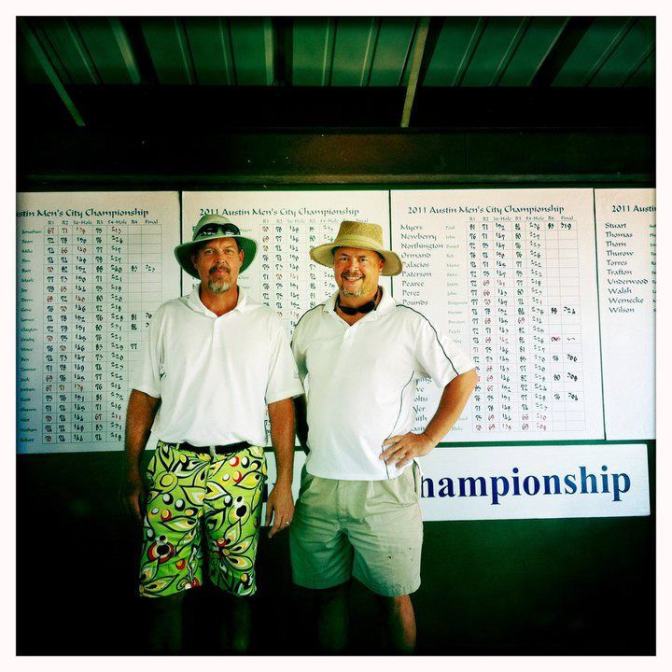
As you who are golfers well know—to this day—I’d like to have that approach shot over again. But so it goes with golf: Kinda like life, you get to learn from your same mistakes over and over again. Downhill lie got you worried? Move the ball back a bit in the stance, slow your tempo down a bit, fire your feet and legs, and catch it clean.
I ended up tied for 24th that year. I had a number of other adventures in Men’s City—both good and bad—but 2008 was my best placing.
Something else—really good—came out of the 2008 Men’s City tourney. Kevin Robbins and I made a connection during our first two rounds, and we’ve been teeing it up together ever since. He took his writing skills to the University of Texas where he teaches sports journalism. If you’ve not heard of him, check out his two excellent golf books, both winners of the prestigious USGA Herbert Warren Wind Award for literature in golf: 2016’s The Life and Wisdom of Harvey Penick and 2019’s The Last Stand of Payne Stewart.
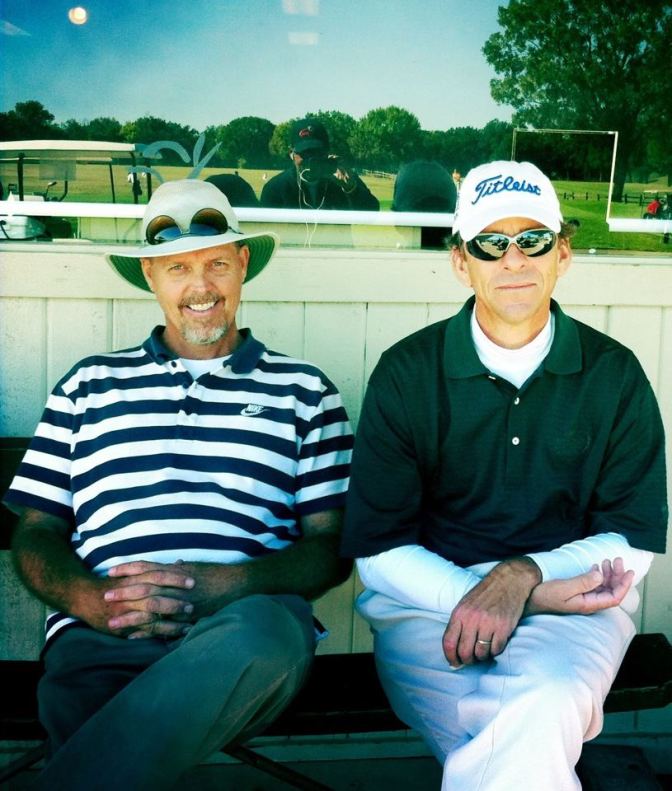
Here we are hanging, with our game faces on, outside the CK pro shop. Photo credits to artiste and smooth swinger Eddy Davis, (reflection in glass).
“My Golf Story, Part IV” – Forthcoming
T. Carlos “Tim” Anderson – I’m a Protestant minister and Director of Austin City Lutherans (ACL), an organization of partners in Austin, Texas working together to serve low-income individuals and families.

Check out any of my books – Just a Little Bit More (2014), There is a Balm in Huntsville (2019), and There is a Balm in Wichita Falls (2024).

 T. Carlos Anderson