The fifth of a five-part series
My book came out on April 1, 2019—no foolin’. I put a lot of effort into promoting the book and just as much energy into teaching it. Additionally, my new gig as director of Austin City Lutherans energized and engaged me. I was connecting with a whole lot of new folks as our non-profit established a preschool in an Austin childcare desert, close to where one of our churches had been located.
I even told Denise at one point that I didn’t miss golf. I hadn’t touched my clubs for months.
Then Covid hit. Wow. Events were cancelled and businesses were closed, some eventually shuttered. People died.
Golf courses closed as well. The PGA Tour shuttered a handful of tournaments, and three majors—The Masters, PGA Championship and U.S. Open—were rescheduled for the fall. The Open Championship, golf’s oldest and grandest championship, was outright cancelled for 2020.
By that summer, my sticks hadn’t been exposed to the sunshine for months as I hadn’t touched a club all year. It wasn’t that I didn’t want to play. I was just doing other stuff—like working. And gardening and making homemade pesto. And writing and reading. Lap swimming. The stuff I enjoy.
Golf courses, initially closed at the beginning of the pandemic, re-opened as we collectively tried to understand the transmission of the Coronavirus better. Golfers were instructed to heed a 2019 rule change, for reasons of sanitation: Leave the pin in while putting on the green, and don’t touch it. Leaving the pin in also helped speed up play as more and more people were playing golf.
The golf surge took off. The great game’s secret was out: An outdoor activity, golf at one and the same time is incredibly challenging, frustrating and fun.
That I already knew.
All the while, Kevin Robbins and I were texting back and forth. We texted about book stuff and work, but mostly about golf. He kept wondering—in a good way—when I was going to come back out. I always promised him it would be “soon.” He informed me of the surge at our home Austin munies.
Soon enough came at the end of August.
Robbins, John Bridges (one of our regulars) and I teed it up at Jimmy Clay on Saturday, August 29, 2020. Robbins played brilliantly. He laughed off two poor shots—at most—and brought it home in 74 strokes. I had some moments, but I was rusty, as expected.
But I was back. I started playing weekly once again.
Back in high school, when a few buddies and I quit football for golf, we heard from the naysayers that we’d regret the decision. Golf, they said, was a game to play when you got older, in the future. Honestly, my “best decision” had nothing to do with what I would or wouldn’t be doing in the future. I chose to do something in that very moment that was much more fun, rewarding and satisfying—for me—than playing football. Did I mention that I wasn’t much good at football?
Now, 50 years into this “best decision,” it’s become an even better decision. Do I even need to say it? There are no regrets whatsoever.
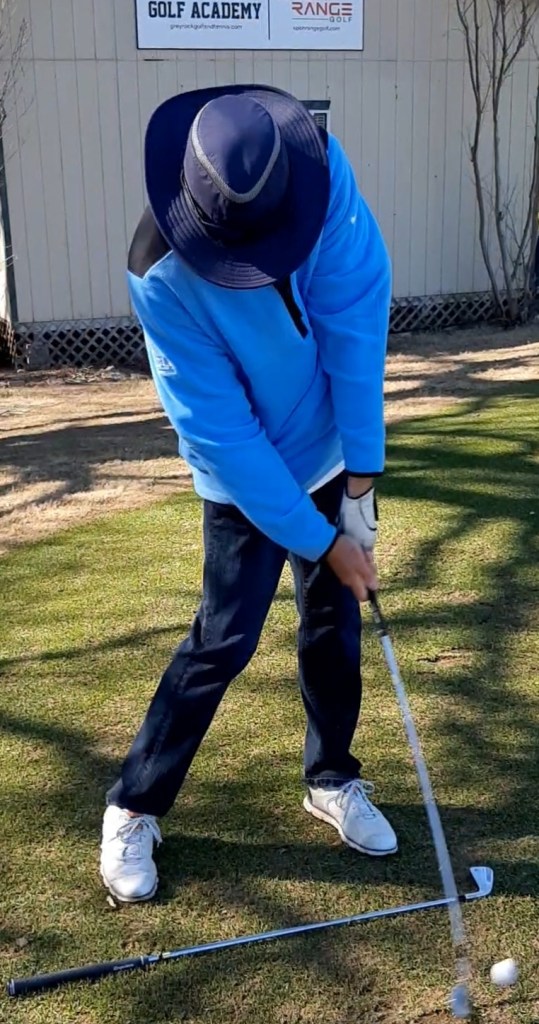
Golf is the rare sport where you can play quite well as you age. The “reaction sports”—football, basketball, baseball, softball, swimming, track, volleyball—favor, of course, teenagers and young adults. You better make hay before you turn 30, because your best playing days vanish from your grasp before you know it. In the sport of golf, you can actually get better as you age. Golf maturity based upon experience—actually learning something from your typical mistakes—can result in better decision-making: which shots to attempt or not, and how to channel your on-the-course disappointment and anger into positive motivation rather than letting them derail your round. Golf in many ways is a microcosm of life.
A bit of golf maturity plus a big assist from teaching pro Mike Marak combined to help me play my best golf in the decade between my 43rd and my 52nd birthdays.
And now as I stretch to a 65th birthday, as I said at the beginning of this five-part post, golf has taken on a new wrinkle for me: It’s become my fountain-of-youth pursuit. I love getting out. At the course, I get to enjoy the great outdoors, I get to walk six miles (or more, if I hit it crooked) and I get to connect with golf buds and/or meet new folks.
And I certainly haven’t thrown in the towel with my golf grind.
I’m still trying to go low—tracking my shots, reviewing my rounds, and maintaining a GHIN handicap. Good friends know that one-third of our backyard patio is a putting green. And I recently retired my trusty Cleveland TA3 irons after 23 years. I’ve fallen in love all over again—hard—for a new set of Mizuno Pro 243 irons. Forged cavity backs, they’re very similar to my old TA3s. Their lofts are a little stronger—helping me maintain the same type of iron distances I’ve had for decades—and their feel is incredible.
And I’ve played The Geezer, the Austin Men’s City Senior Championship, for the past five years, after not having played from 2017 to 2020. I’ve proven that I can hang in the middle of the pack with the “young” guys, so I’ll move up to the Super Senior division this fall—white tees, 60 years and older. Again, I’ll be in contention.
Yup, I’m still drawn in. And somehow, if I can still play well, maybe I’m not quite as old as it says I am on my driver’s license. If I can still keep it around par, maybe the guy I see in the mirror with the wrinkles and the age spots still has some currency in terms of physical abilities. If I can go out and card four birdies in a round, maybe my sense of what I can accomplish—in various other pursuits—is buoyed and enhanced.
Fleeting? Self-delusionary? Perhaps. I’m certainly at the age where anything could happen health-wise, making my next “break from golf” an obligation rather than a choice.
I’m grateful to still be in the game. I’ve been both lucky and blessed not to have had any significant illnesses or injuries that have kept me from playing all these years. My fingers are crossed for a long continuance—one hole, and one round at a time.
Thanks for having come along this journey with me.
If you’re interested, there’s a bit more.
ADDENDUM—NINE OTHER STORIES + A POTPOURRI FINALE THAT MAKE THE CUT
The following golf stories, mostly unrelated one to another, didn’t fit the flow of the narrative in Parts I–V, but they have made the final cut.
Denise and Tiger
Denise doesn’t play golf. Of course, we had the obligatory “golf date” at a driving range shortly after we met—I was on the golf team, you know—but that was it. She does, however, love to watch golf. Over the years, we’ve watched many a final Sunday afternoon round together, following the exploits of Phil, Tiger, Sergio, Rory, and all the others. She especially liked Tiger. The guy was fit and, for her, he broke the mold of typical boring golf guy (my apologies to Jim Furyk, David Toms and all-timer Tom Kite).
Like many women (and men), she was hugely disappointed in Tiger’s marital infidelity, exposed in November 2009. Tiger and his then-wife Elin had two young children, and had been married for five years. At the time, Denise described Tiger in vivid terms: “What a fudgin’ a-hole.” Not an exact quote.
After the news of his cheating scandal broke, Tiger took some time off from the tour. His first tournament back the following year was The Masters, played in April.
I was watching the tournament on Saturday afternoon, seated on the couch in our living room. Denise was busy-bodying around the house with something. She stopped by the couch and saw that I was watching golf.
“What are you watching?”
“The Masters.”
She paused a bit, and then asked me in a gentle tone. “Is Tiger playing?”
I responded with a drawn-out, “Yes.”
She paused again, as if gathering herself. She bent down to get closer to my ear as she looked at the screen. “How’s he doing?”
Ha.
Tiger’s behavior may have been off-the-charts despicable, but there was no denying that he was must-watch golf TV. Just ask Denise. She joined me on Sunday to watch Tiger finish T4, five shots behind winner Phil Mickelson.
“Golf is Dumb”
The LPGA had a three-year run, 1999–2001, at Onion Creek Country Club in Austin. In 2000, I took my three kids out to the tournament. Lauren was 13, Alex was 10, and Mitch was 8. We went out on Saturday for the 72-hole championship honoring the memory of Austin golf legend Harvey Penick. It wasn’t too crowded so we had nice access to watch the action.
We were spectating on #18, the long par-5 that finishes up the hill behind the clubhouse. We were at the fairway ropes on the hole’s right side, and I knew that Laura Davies was on the tee box. I set the stage for my kids. Davies, I told them, was one of the best players on tour and she hit the ball a mighty long way. She also happened to be leading the tournament.
Davies took a rip and hit a big drive with a bit of a fade. The ball rolled up no more than ten feet from where the four of us stood. We stayed put and I told my kids that we’d get to see the tournament leader hit her next shot, right in front of us.
I also told my kids that Davies was the female version of John Daly, one of the longest hitters on the men’s tour. To give them some perspective, I added that Laura Davies hit the ball about as far as I did. I meant it as a complement to the British LPGA touring pro.
Moments later, the 5’10” Davies ambled up to her ball. It was a great drive and she had a good angle to get to the green in two, giving her a chance at eagle or bird.
Davies, her blonde hair cascading over her visor, talked up the strategy of her next shot with her caddie. More spectators gathered behind us. She waited for the green to clear, and eventually pulled a hybrid and addressed her ball. She took a hefty rip and the ball sailed away. It didn’t quite make the green but ended up in handy position for an uphill chip for eagle. We oohed and aahed and cheered her on.
Davies trudged off confidently. Par 5s were her bread and butter.
Alex looked up at me. The expression on her face was stern. She wasn’t going to be fooled.
“Dad?”
“Yeah,” I offered back.
“She hits the ball farther than you.”
Boom! I guess girls rule, and boys drool. Or something like that.
By the way, Laura Davies did win the tourney the next day.
The following year I took Alex on a golf field trip. What can I say? The kids enjoyed sports and related activities. Individually and collectively, they were into basketball, swimming, and soccer. Of course, I was going to encourage them toward golf the best I could.
School was in session, and I took Alex out of class for a whole day. There was a par-3 course about a half-hour away in New Braunfels—we played nine holes and had lunch.
Alex showed natural ability. She took the putter straight back and brought it straight through the ball right at the target. On full swings, she had little trouble getting the ball in the air. She gave plenty of effort. Alex has always been an achiever.
It was a fun day for the dad-and-daughter duo.
Later that evening, Alex came down the stairs from her room.
“Dad,” she said, “I figured something out.”
“What’s that?”
“Golf is dumb.”
All these years later, she’s hardly touched a club. The girl has her priorities figured out—I’ll give her that!
A Favorite Golf Compliment
I served St. John’s/San Juan in Austin for close to twenty years. A few of my congregants were members at Onion Creek, giving me the opportunity to play the course every once in a while.
Bernie Thomas was a retired carnival owner and WWII veteran. Originally from South Dakota, he built a carnival business started by his uncle into a successful touring operation that provided rides and shows for fairs and events in fifteen states and Canada. It was only after he retired in 1986 that he started to play golf on a regular basis.
That’s how you did it back in the day. You worked hard and saved money, and then upon retirement, you joined the country club and played golf. Remember—golf is the sport you can play when you get older. That’s how Bernie did it. He was a max 36-handicap, but he enjoyed himself on the course and even had four aces to his credit.
Bernie had me out to Onion Creek one day, and I joined his group of regulars for 18 holes. Another fellow in the group, just like Bernie, was a WWII vet on the verge of 80 years of age who didn’t start playing golf in earnest until retirement.
I don’t remember how well I was playing that day, but I was doing my thing: hitting long drives, getting chances at birds, saving pars here and there. I was half the age of my playing partners that day and, unlike them, I started playing the game when I was young. Of course, my game is going to look, in comparison, like it’s something special.
In the middle of the back nine, after I hit another long drive, Bernie’s buddy looked me square in the eyes and slowly sneered: “Misspent hours during your youth, young man.”
Not to be denied—he was exactly right! It’s been a favorite golf compliment indeed.
Place Your Clubs on the Flagstick
This one’s basic, but think about it: It seems to happen every other time you’re out playing a round. You get up to the green on a particular hole and someone from a group in front of you has left a wedge near the green.
As teenagers back in the day on our home course in suburban Chicago, we’d make this faux pas on a regular basis. I remember leaving my pitching wedge on the side of the second hole’s green at MP, a long par 4, and having to run back to get it after I discovered, on the third hole, that I didn’t have it in my bag.
When I arrived at the second green, there was my wedge, right where I left it. A volunteer marshal, an old retired guy, was sitting in his golf cart near the green. The main job of a marshal is to keep play moving. He motioned me over because he knew exactly what was going on. There was no one behind us, so he took advantage of the situation to teach me a lesson.
Hey, sonny, he said, go take the flagstick out of the hole and lay it down on the green. I did as I was told. Now, he continued with raised voice, lay your club down on top of the stick. He said no more as I did it and simply gave me a nod. I nodded back. Then he said that if I did this every time, I’d never forget a club on the green again.
Yup, the old guy knew what he was talking about.
I’ve shared the same tip countless times with guys who come back looking for the club they left orphaned after having chipped up to the hole. Most of the time, they’re younger guys on the receiving end of this treasured institutional knowledge.
Another Great Tip and a Great Guy
David “D.J.” Johnson is one of a kind. We first met at Jimmy Clay’s twelfth hole, a longish par 3, in 1999. He was working for Ausitn’s KVUE-TV at the time as the weekend sports anchor. “Beat the Pro” was a segment KVUE featured for twelve weeks in the summer, culminating with a televised tournament between the twelve weekly winners. D.J. was working Jimmy Clay’s twelfth hole the day I happened to hit the closest shot in the four hours that the KVUE crew was out there. He called me that night to let me know my shot held up.
The tournament was a hole-by-hole elimination shootout at a private track, River Place Country Club, in northwest Austin. I brought Alex and Mitch out with me the day of the shootout. They scored camera shots in the half-hour special, televised locally. I got eliminated, however, about midway through the shootout.
D.J. and I discovered we had a number of things in common. I was a Lutheran minister and he was a Lutheran congregant. We had oldest children about the same age. And we both loved to tee it up. We started to play together. For the twenty-five-plus years I’ve known him, D.J. has fluctuated between a 7 and an 11 handicap.
Here’s the deal: D.J. is one of the most extraverted people I know. And one of the most positive. His energy is relentless, and his enthusiasm is infectious. He’s offered to caddy for me a number of times through the years for tourneys, and I’ve taken him up on it every time. To boot, D.J. is pretty good at reading greens.
Jeff Hodges caddied for me a handful of times for Men’s City. The quiet and steady type, Jeff was on the bag for me during the final round of Men’s City 2008 when “we” fired an even-par 71 to close. Thanks, Jeff.
D.J.’s caddying style, as you’ll expect, is all encouragement and all support, all the time. I’ve gone low a number of times with D.J. on the bag. The opening round of Men’s City 2014, I struggled mightily with my putter at MoWilly and tallied an 80. I hit 15 greens and had 40 putts, cresting my average number of putts per round by eight or nine strokes. The bloated 80 put me four to five shots over the next day’s projected cut line. D.J. came out with me that Friday to Muny. We knew that we needed to go low, go low early, and finish low. Piece of cake, right?
I sank a seven-footer—something I couldn’t do the previous day—on #1 to save bogey. I birdied #2, my first bird of the tourney, and eventually finished the front side at even par. At that point, I knew I had a fighting chance to make the cut. A birdie on #12 got me under par for the first time that day. On #14, a par-5 that parallels Lake Austin Boulevard, I pulled my drive toward the long telephone-pole-supported mesh fence protecting drivers on the road from errant golf drives. I had to take a penalty drop. I planned to hit a low hooking 3-iron for my next shot, my third, off the hardpan. As has happened before off hardpan—I’m not easy on 3-irons—upon contact the clubhead flew down the fairway as my ball squirted toward the cedar trees in the rough on the right side. D.J. and I looked at each other dumbfounded. The shaft had snapped close to the clubhead.
Fortunately, I had a window through the trees and coaxed a 9-iron onto the green, about 30 feet away. Moments later, I canned the putt, which had some six feet of right-to-left break, to save par. Mike DiLeo, a longtime friend and golf buddy and his friend Tommy Holt, had come out to watch for the last few holes. I had a mini-gallery. Along with D.J., the two of them were going nuts when the ball found the hole from distance. With the 3-iron casualty, it was a crazy and great par. It kept me at -1 for the day.
I came to #17, the par-3 over the pond, at even par. It measured 175 yards that day. I blocked my 7-iron right, and it ended up on hardpan a bit past hole high. It’s tough for me to pitch a lob wedge high off of hardpan, and D.J. said to close the face and run it up. I agreed and set my hands forward hacked it out. It was on a great line as it released on the green . . . D.J. called for it to go in, and boom, it hit the pin and disappeared! Now D.J., Mike and Tommy were hootin’ and hollerin’. The bird got me back to -1. I hit a great drive on #18, the short 4-par, chipped up and canned a 5-footer for bird to shoot 69.
That bested the cut line by one shot. Every year in Men’s City, there are one or two guys who come back from a miserable first round to keep playing on the weekend. I was happy to be that guy in 2014.
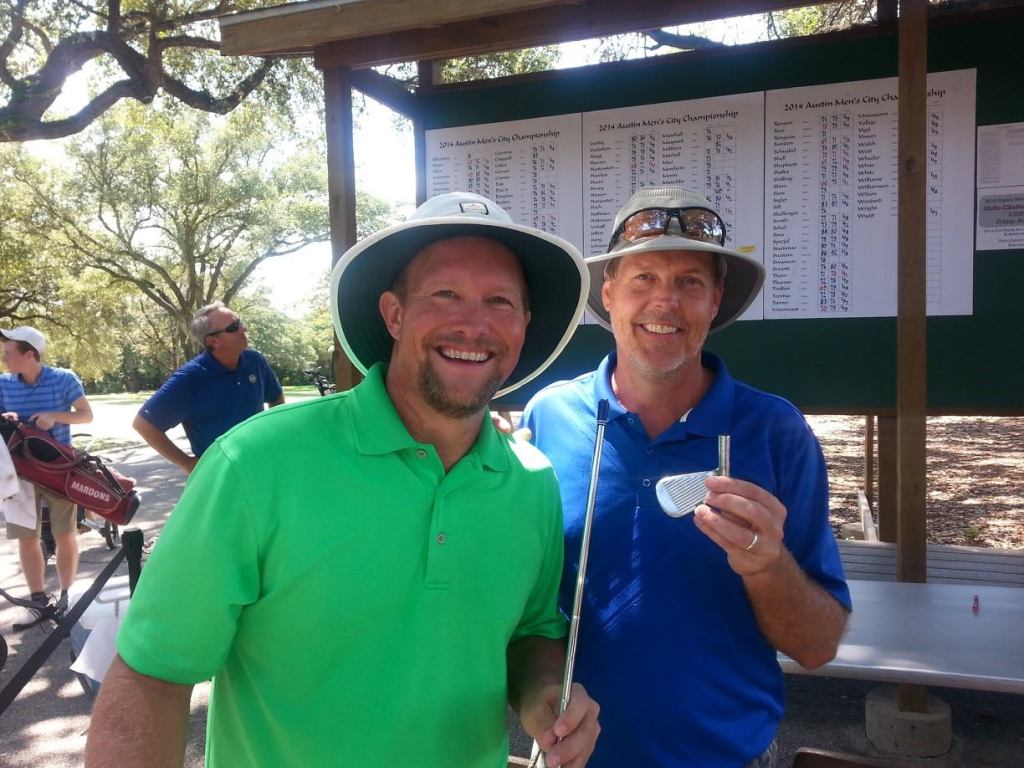
From all the golf we’ve played over the years together, D.J. claims the best golf tip I’ve ever given him has nothing to do with grip, swing tempo or hip turn. Nor does it have anything to do with practice drills or on-the-course strategy.
Here it is: Especially when you’re walking 18 holes, make sure to wear two pairs of socks instead of just one.
Your feet will thank you for it.
Another Great Guy Who Knows You Can Get Better at Golf as You Age
I got to know Chris Blevins, aka C.B., when Mitch was playing high school hoops. C.B. coached a summer team that Mitch played on for two years.
C.B. played football at Dripping Springs High School. He’s an athletic guy who works out and stays in great shape. To this day, he plays in competitive pick-up basketball games at a couple of gyms around town.
He played his first round of golf after graduating from high school. With righty clubs, he hacked it around that first time out. He told his buddies afterwards that it would be really cool if there were such a thing as lefty clubs, since C.B.’s a lefty. It was a “I could have had a V-8” moment.
After we got to know each other, C.B. found out I played golf. He wanted in. I invited him out and we met at Roy Kizer to tee it up. Admittedly, I was a “black tee snob” back in the day, always having to play from the tips. In hindsight, I shouldn’t have done this, but when C.B. came out with us to Kizer in 2011 or so, I told him that if he wanted to hang with the big boys—and he did—he needed to play the black tees with us. He was probably a 15-handicap at the time.
I birdied the first two holes, and to this day, C.B. claims I shot under par. Actually, I shot an even-par 71 that day. Suffice it to say, C.B. was impressed. It’s true that if you want to improve your game, it helps to play with golfers who are better than you. You’ll learn by observation and you’ll pick up some good tips and habits.
C.B. kept hanging out with the big boys—me and my golf buddies—and worked on his game. He also had his own golf buddies, a few of them from that first and last round C.B. played as a righty. My group plays the ball down and doesn’t take mulligans. C.B.’s group, on the other hand, plays the ball up (that is, adjusting your lie to your advantage) and takes the occasional mulligan.
There’s no judgment here, per se. Different groups play for different reasons, and if everybody in the group is playing by agreed upon rules, it’s all good. Most beginners take mulligans, a second attempt at the same shot after a horrific first attempt. It’s a good way to learn from what you did wrong the first time, in the moment.
Here’s the catch, though. If you want to get better at golf, you need to play the ball down as it lies and ween yourself off the habit of taking mulligans. After you’ve played enough golf, bad shots—instead of turning into do-overs—can be very instructive of what to do and what not to do.
By 2015 or so, C.B.’s game had improved steadily. He was grinding away and got his handicap under 10. After a few of our rounds at that time, he’d tell me that he was hanging with some of the big boys in my group and even beating them.
I took C.B. aside. He was still playing the ball up, and I told him you’re not “beating” anyone until you start playing the ball down. Guys who play the ball down, I explained, and guys who play the ball up are playing different games and there’s not a straight-up comparison. I said it’s as if you’re playing hoops and you’re open for a shot, and instead of taking the shot, you yell out “Freeze.” You then tell everyone to take a break while you line up your shot.
Absurd, right?
C.B. saw what I was getting at.
Fast forward to just a few years ago. C.B. was with us at MoWilly and we were going back and forth with good shots all day. When we got #18, he was one over and I was two over. We both hit good drives and he hit his approach on the green for a lengthy birdie putt. I stuffed my wedge to three feet. He was convinced that his opportunity to beat me for the first time ever was evaporating before his eyes. He cozied up his putt to tap-in distance, carding a par for a wonderful 73. I had never seen him play better. I then set my ball down to putt in a tying birdie. Somehow, I missed it. The celebration commenced. C.B. couldn’t believe it. He even wondered if I missed it on purpose. Hell no, I told him. Fair and square, C.B. had taken down his mentor after all these years. A great golf memory for him and I’m more than happy for him.
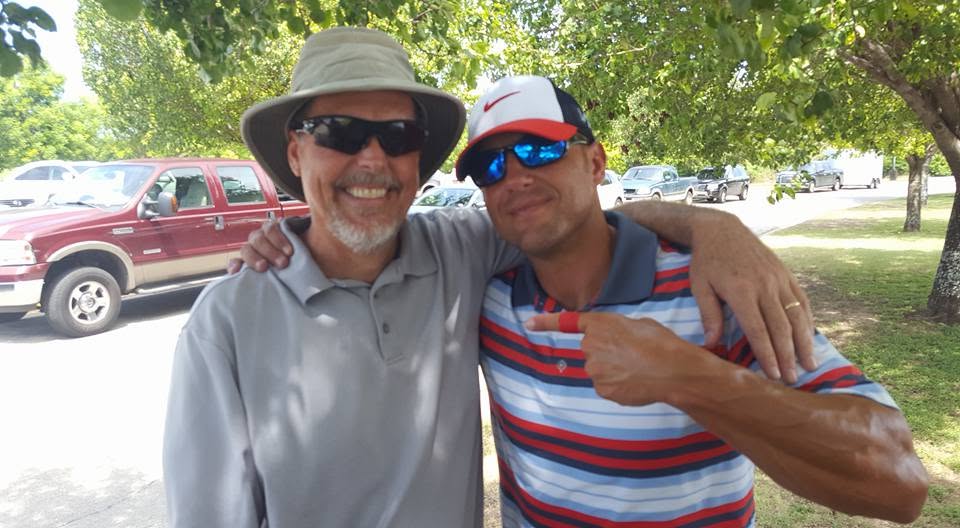
There’s no one I know who has improved their game as much as C.B. He’s crested 50 years young now and is still striping it. He’s got a great short game. Like me, some of his best rounds were played after he turned 40.
You can get better at this game as you age.
More Basketball, Swimming and More Golf
While I was a student at Augustana College, there was a guy who worked in the admissions office who was in great shape. He was a graduate of the college who had competed on the wrestling team. I noticed that besides running and lifting weights, he also swam. I also lifted weights, ran, and played hoops, but swimming as an exercise strategy was off my radar. I made a mental note.
While I was a student at Luther-Northwestern Seminary in St. Paul, Minnesota, my main social group consisted of the other students who played pick-up hoops. We had a small gym on campus, and we played hoops religiously every Friday afternoon. During the winter months, we also had a seminary basketball league at the same crackerbox gym. I wouldn’t have made it through what ended up to be six years of graduate school without hoops and my hoops guys.
While on internship in Chiclayo, Perú, the country’s fourth largest city, I hooked up with some locals I met at the city’s main gymnasium and played in a league. Like most all Latin American countries, Perú is a soccer country. But hoops is an international game and Chiclayo had some decent players. I was invited to join the city’s travelling team for some type of a tournament, but I declined because of work responsibilities.
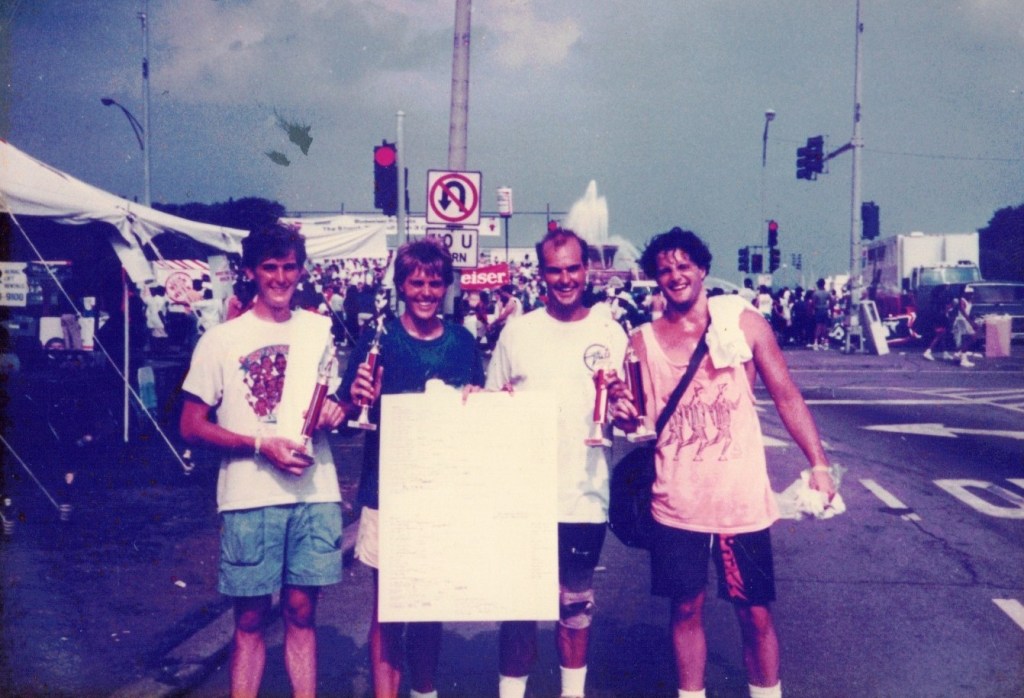
In 1990, right after I graduated from seminary, I joined my brothers Mark and Mike in a 3-on-3 tournament called “Shoot the Bull” held at Grant Park in downtown Chicago. One of Mark’s buddies rounded out our four-man team. This was at the beginning of the 3-on-3 wave, the second summer that this tournament was held in Chicago and it was sponsored by the Chicago Bulls. We entered the “played in high school” level. These were half-court games, and S. Columbus Drive in the park was closed off and planted with rows upon rows of portable hoops. There were hundreds of teams competing, and teams were placed in 16-team brackets. It was a Friday–Sunday deal.
Mark and I were both hotshots from distance playing for our high school team. Mark’s a year younger than me and attended Augustana College as well. While there, we teamed up to win the fraternity league at Augie one year. Our brother Mike was more a broad-shouldered banger. We had a distinct advantage in this 3-on-3 tourney. Regular buckets were worth one point, and buckets at the “three-point line” counted for two, doubling your fun and chances. We won our first game against another family team—the Koomjohn brothers, a name I had never heard and haven’t heard of since—who played pretty well. We were just a bit better than them. They seemed quite stunned when we put them down.
We kept it rolling in the second game, fueled by many a clutch bucket from distance. Our third game, played on Saturday against a team that only had three players (due to an injury the previous day) was a classic grudge match that went down to the wire. White guys vs. Black guys. Suburbs vs. City. There were no refs, and you called your own fouls. There was no clock, either. First team to 21, got to win by two. The guy I was guarding, their best player, toward the end of the game, started calling fouls on me every time he missed a shot. Yeah, not during the shot but after he saw that the shot didn’t go in. Bush league. After another missed shot and late-called foul, I grabbed the basketball and held it behind my back and got in his face. I told him no way that was a foul. He countered that it was and demanded the ball. I said no and continued to hold it behind my back. I told him that he knew that wasn’t a foul. He didn’t respond. We stood face-to-face and silent for a moment. Then he backed down. He walked away and said, alright, let’s play.
A rather large crowd had gathered watching our game as it was tight and intense. Our sister, Maria, a high school hoopster herself, was there that day to give us some support. She says that toward the end of the game she heard someone comment behind her, “Man, these white guys are deceiving.” Ha—another classic and memorable compliment.
Their guy played it straight after our confrontation. We eventually wore them down as they only had three guys and we were able to sub out every couple of minutes.
On Sunday, we played a team that outsized us for the bracket title. We kept striping it from downtown. Mark especially had a good game in this last one. We won the bracket.
Six months later, Mark was playing pick-up hoops at a gym in Chicago. A guy approached him and said that he remembered Mark from the Shoot the Bull tourney. His last name was Koomjohn, and he told Mark that they ended up winning the consolation bracket. That game, he continued, you guys played on Saturday was a good one. He said he watched it.
“Hey, who was that guy on your team that wouldn’t give the ball back?”
Mark laughed and said, “Oh, that’s my brother.”
He was pretty intense, the other guy said. Then he asked, what does he do?
Mark said, “He’s a minister.”
“You’re shittin’ me.”
Yes, by that time I was in my first call at Holy Cross Lutheran in Houston. The church had a large all-purpose building with a basketball court, a commercial-sized kitchen and classrooms. The entire floor of the gym was thinly carpeted, but the basketball court was regulation size. We had a church-league team, which I, of course, joined. There were open pick-up games one evening during the week.
The first league game I played in was against the team from Zion Lutheran. They were led by my good friend and seminary classmate, Kerry Nelson. His team won a high school state championship in North Dakota, and he played NAIA college hoops at Concordia–Morehead. Kerry’s 6’5”, and he was pretty damn good in hoops.
When we played in our crackerbox gym in seminary, Kerry dominated. When you’re big and tall and playing in a small gym, you’re pretty much everywhere on that court. That was Kerry.
Kerry got to Houston a year before I did. I hadn’t seen him for a while, and I soon found out that his game was still stellar. Even in a regulation sized gym, he dominated. We got whooped. Welcome to Houston, Tim.
There was a younger guy on Kerry’s church team who was a pretty good player. Lots of energy, lots of spunk. This guy would come to Holy Cross to play in our evening pick-up games. During my second year in Houston, he and I almost got into a fight during one of those pick-up games. By this point, I was thirty years old. I had lost a step or two. While playing defense, I could see where an opponent was going to pass the ball—I could intercept it—but I was no longer quick enough to close the deal. More often than not, the ball would elude my reach. I had put on a few pounds and my back was not in good shape. Running, jumping and pounding away on a concrete floor, albeit carpeted, was not helping my back.
After I almost got in the fight with the other guy—in the gym at the church where I was one of the pastors—I made another decision.
I went cold turkey. My basketball days were over. Denise and I decided to join the YMCA. Our local Y had two lap pools, indoor and outdoor. Yup, that mental note was retrieved from my college days. I decided to start swimming on a regular basis.
This great decision is now thirty-five years in the rearview mirror. I’ve been swimming—a mile at a time, thirty-two laps—ever since, twice or thrice a week. Denise joined me in the pool routine some twenty-plus years ago. Swimming, besides being easier on the back, is a great stretching exercise every time you take a stroke.
I didn’t think about it when I was younger, but I’m convinced that swimming has been a huge help to my golf game, specifically, to the full swing. A few years back in The Geezer on a final day Sunday, I was paired up with two other guys who, like me, were competing in the regular senior division with the younger guys (50 to 59 years of age). The three of us were over 60 years of age, and a combination of pride and rationalization (“I’ll prove I still got game . . . “) kept us from having signed up to play in the super-senior division (60 years and up). The three of us were in the middle of the pack. We were commiserating about how we used to be better when we were younger—classic old-guy banter. The other two complimented me on being able to maintain a higher swing speed after all these years. I thanked them and said if only swing speed helped with the short game!
Good genes plus favorable luck with an assist to swimming all these years, I’m convinced, has helped me to yet to take the club all the way back and bring it through with consistent power. Improved technology certainly hasn’t hurt my cause, either.
Pastor, aka TA, Has Sex(tuple) on the Golf Course
I played in the Austin City Spring Championship a few times, years back. You had to be 25 or older to compete, the definition of a mid-amateur tournament. It was usually held at MoWilly. One particular year, around 2010, one of my playing partners on the first day was Bart Antle. Bart’s a great guy and a joy to play with, and a two-time Geezer champ who has a repeatable and consistent swing.
The guys who tee it up with me know that I mark my ball uniquely. I love the color blue, and I put my initials TA in bold Sharpie blue on one hemisphere of my Titleist ProV, and I put a blue line on the opposite side of the ball. My ball stands out and it’s obvious that my ball is not your ball.
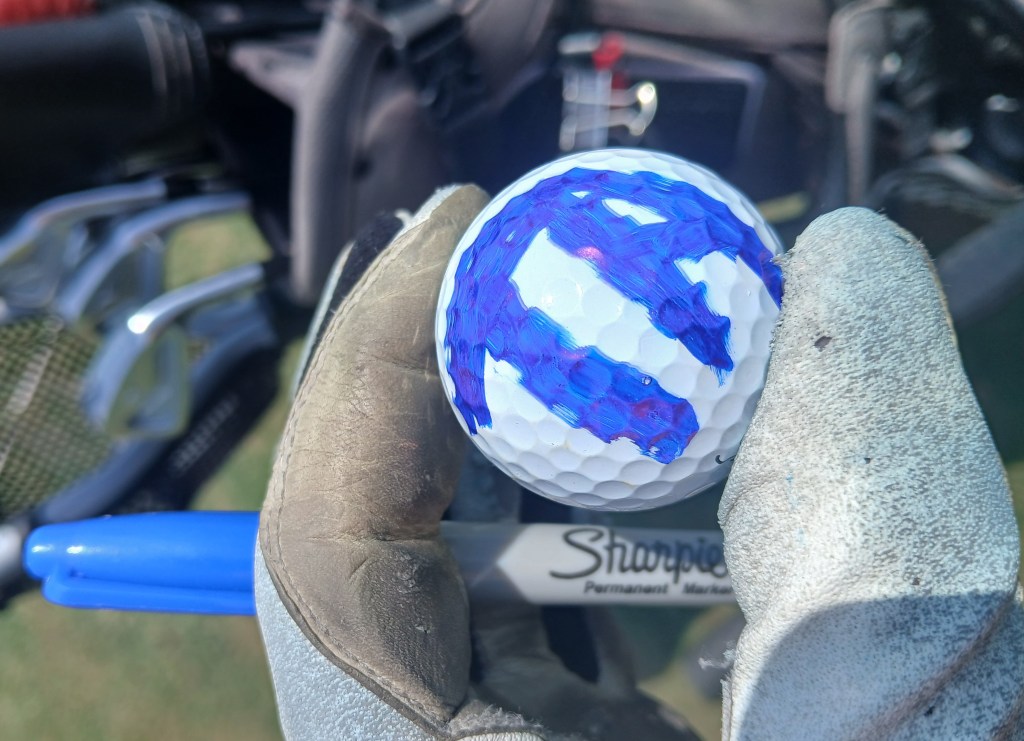
MoWilly’s 7th hole, an up-the-hill par 4 that measures 422 yards, is a good test. The straight-away fairway beckons as there are plenty of trees left and right, serving to block off the approach-shot paths resulting from wayward drives. On the first day, I unfortunately hooked my drive under a big oak that separates fairway safety from the danger zone left. There had been plenty of rain that spring and the rough was stout. Initially, I couldn’t find my ball anywhere in the thick grass near the tree.
Bart and our third player came to help me locate the ball. I knew it was by the base of the big oak, but we ventured from the tree further up toward the green to try to find it. I eventually came back toward the oak, and there it was—a golf ball. I quickly played my second shot. I didn’t want our group to get “on the clock” for slow play. A few moments later, I chipped up onto the green, lying three, and marked my ball. As I picked up the ball, I realized it wasn’t mine. I had played the wrong ball. Oops.
I had to go back and place the ball I had hit back where I found it. Then I had to go back to the tee box and start all over because of a lost ball. It turned out that I had hit the ball of a competitor, the group behind us having hit their drives up when my group was looking for my ball as we ventured further up the fairway. I apologized to them for my faux pas.
I was lying five as I teed my ball up—two-stroke penalties each for a lost ball and playing another competitor’s ball. I didn’t play the hole well from there. Moments later, I putted out for a 10, a sextuple bogey. I ended up shooting an 83 or so which put me toward the bottom of the field, yielding an early tee time the next day. Bart played well on Saturday and had a much later tee time for the next day.
I played better on Sunday and finished lower-middle of the pack for the tourney.
A few weeks later, I saw Bart out at MoWilly.
“Hey, Rev,” he greeted me. “Guess what I found on the second day of the tourney?”
He told me that when his group got to #7 on Sunday, they were having to look for a ball, again, in the rough on the left side by the big oak. As they were looking, he found a ProV with a big blue “TA” scribbled on it.
We both laughed.
These days I put even more blue on my golf ball than I did before. One occurrence of “sex” on the golf course was enough for this pastor.
Muni-Tough
I’m a public course guy. It’s got nothing to do, per se, against private clubs.
First off, I didn’t and don’t have the income to be a club member. Private courses—especially their greens—are in better shape than most public courses. There’s a price tag that comes with that. Initiation fees, monthly dues, and special assessment fees add up. It also helps that private course greens, typically, have less foot traffic than public course greens.
Second, I love living in a city that has five decent public tracks—my regular courses. If I were a private course member and shelled out private course dues and fees, I wouldn’t be venturing away to other courses and paying additional green fees. I’d be pretty golf-monogamous if I were a private course member. As a public course guy, I get to play around, so to speak.
I’m grateful, of course, for all the invites I’ve received over the years from family, friends and acquaintances to their private tracks.
At the end of the day, though, I’m a municipal course guy who does his best to play Muni-Tough. What does that term mean? It means having to play on greens that might not be in the best shape; teeing off of uneven tee boxes; and, playing your ball where it lies, hitting off of hardpan or areas of sparse growth. It also means keeping a good eye on your ball if you happen to hit it in an adjacent fairway. As you might know, there are a handful of public course players who never learned the maxim: If it’s not your ball, don’t pick it up.
The purveyor of the term Muni-Tough is another guy—Eddy Davis—who worked at the CK pro shop. Eddy has a smooth touch as a golfer, artist and person. And as a cancer survivor, he’s the one who introduced me to the line of Tilley hats, to keep all those sunrays off your head, ears and face.
Eddy played baseball growing up in Houston and hooked up with golf a little later. He’s got the sweetest putting stroke of anyone out there. He’s a calligrapher as well, who did the scoreboards for pro events, junior golf tourneys, and the Skins Game at the CK prior to Covid. Back in the day, Eddy was the one who gave me an envelope of fifty-three twenty-dollar bills and change after I won a two-week holdover skin with a bird on #14 at Jimmy Clay.
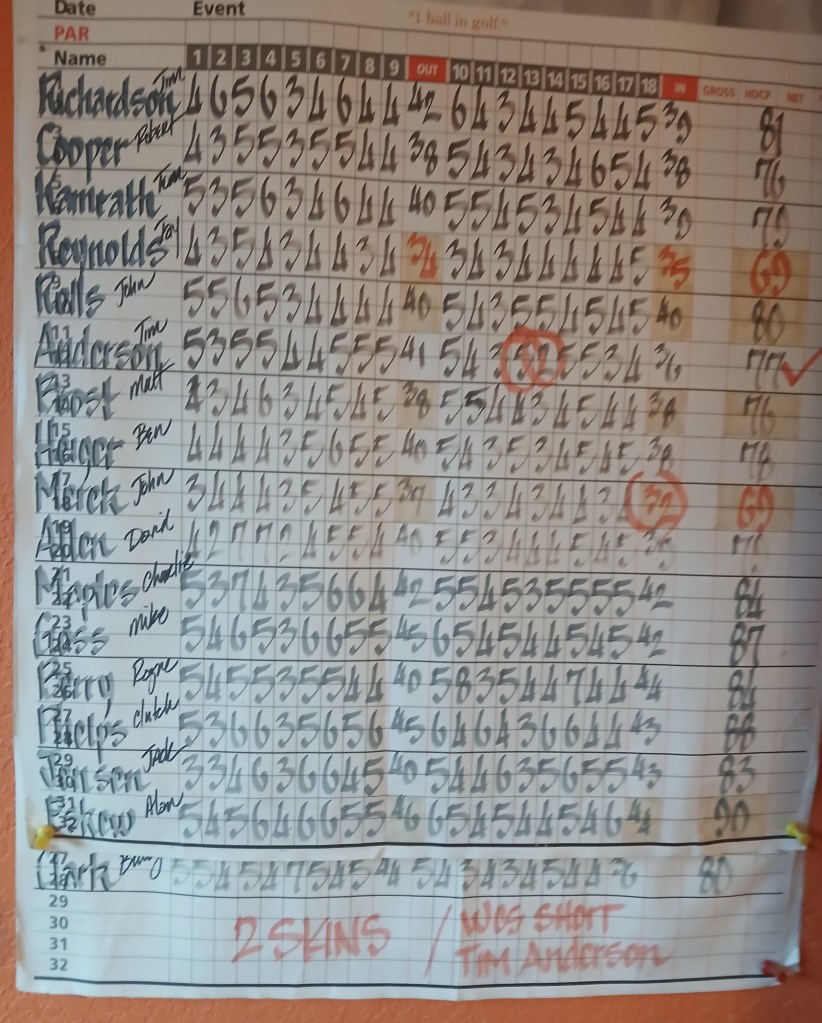
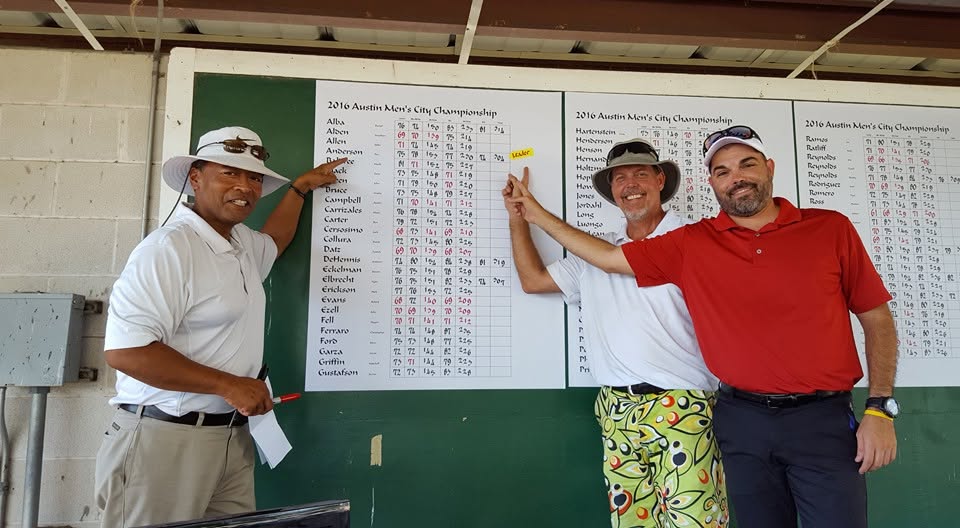
Potpourri Finale
I qualified for the Illinois State Amateur in the summer of 1983. My 75 at Waukegan’s Bonnie Brook Golf Course was on the number—meaning that 76 and above were cut. The tournament itself was held downstate at Bloomington Country Club, a tight track. In those days, I did not have the game for a tight track and chopped my way to an early exit with two tallies in the upper 80s.
I don’t remember the details, but I stayed in Champaign with Denise and her parents, about an hour away from Bloomington. June, my mother-in-law-to-be, drove me to the tournament and back on the day I missed the cut by a mile. I was a bit embarrassed by my poor play, but she thought I was hot toddy for even making the tournament. That helped soothe my disappointment. Thanks, June.
I qualified for the Texas State Mid-Amateur in 2010. Just like in 1983, I qualified on the number with a 78 at UT Club—get this—by sinking a 20-foooter for par on #18 and then emerging victorious from a one-hole playoff. Six of us competed in the playoff for three spots. Kevin Robbins also played in the qualifier but didn’t move on. He walked with me on the playoff hole and watched my par get the job done.
The tournament was played mid-September at Boot Ranch in Fredericksburg. I had a great practice round the day before the tourney. That’s pretty much a guaranteed jinx. My 83–80 didn’t make the cut for the final round.
Here’s the moral of this short story: If you qualify for a tournament on the number, as I did each time, don’t make guaranteed accommodations. There’s a good chance you’ll get to go home a day early.
I have two aces to my credit, and my third is getting closer all the time. My first was on New Year’s Eve in 2010. Jeff Hodges and I were out at Jimmy Clay. The fifth hole is a shortie, about 115 yards when the pin is deep on the green. That’s where it was—back and right—when I knocked it in with my Mizuno 52* gap wedge. To this day, Jeff says that it wasn’t a “real” ace because the hole is so short. Ha. I had to grind out a good finish that day. I parred the tough finishing hole to bring it in at 79. I didn’t want to shoot 80 or worse on my first ace day.
My second ace was at Jimmy Clay’s twelfth hole, the same hole where I met D.J. all those years before. It measured 186 yards that day, August 18, 2022. There was a touch of south wind behind me, and I absolutely pured* my 6-iron dead-on the pin. After a tight little draw, it took two soft bounces and disappeared. My playing partner that day was a woman who was visiting family in Austin. She was a bit younger than me and played decently for coming to the game at a later age. I was walking, as usual, and she was in a cart. She didn’t see me hit my shot. So, after she hit her shot, she asked me where my ball went.
When I told her that it might have went in, she zoomed forward in her cart. When she got up to the green, I was still more than 100 yards away. She went directly to the hole, bent down and pulled my ball out of the cup. “Yes,” she screamed, “it went in!”
I was cringing a bit, but kept my composure. I played well that day and finished with a 75.
Afterwards, in the CK eatery, over obligatory drinks purchased by the one who makes the ace, I gently let her know that proper etiquette dictates that the shot maker is the one who pulls an ace out of the hole. She didn’t know—it was the first ace she had ever witnessed. We both ended up with a good story to tell.
*Are golfers the only ones who use “pure” as a verb? I’m thinking so.
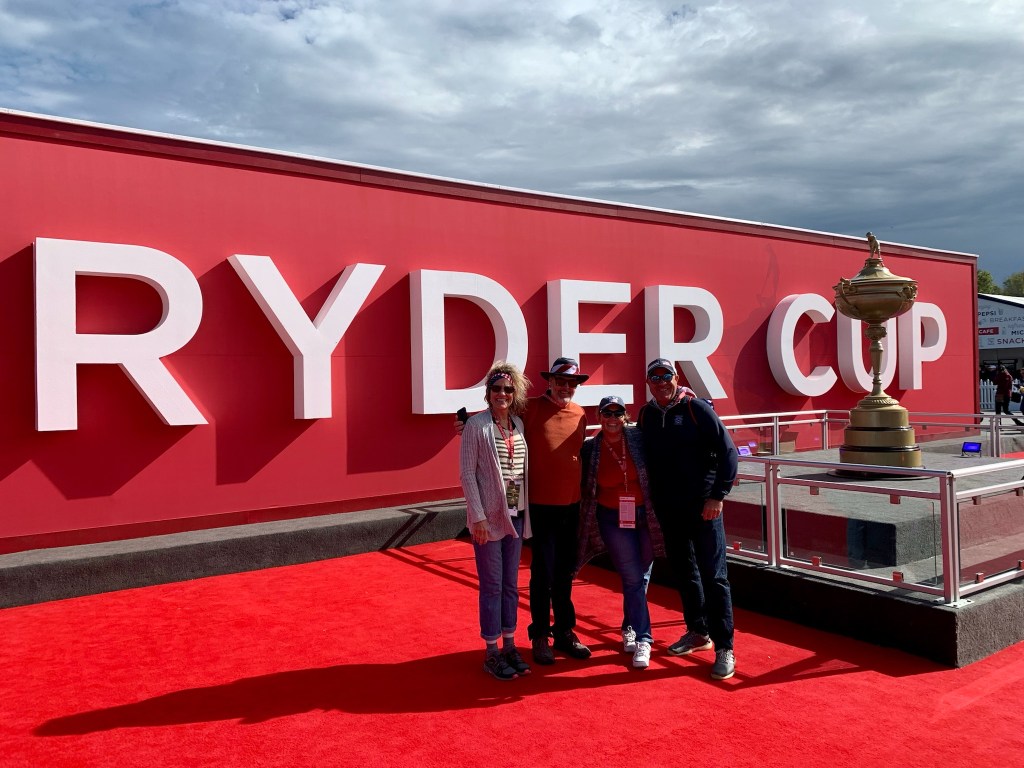
Denise and I thoroughly enjoyed going to the 2020 Ryder Cup at Whistling Straits in 2021. Another Covid casualty of a one-year delay, the tournament’s merchandise was sold as was rather than re-doing all of it. Kenny B. and his bride, Denise’s sister, Kim, were our hosts as they lived about 45 minutes away from Kohler, Wisconsin at that time.
As you’ll remember, Team USA trounced the Euros 19-9.
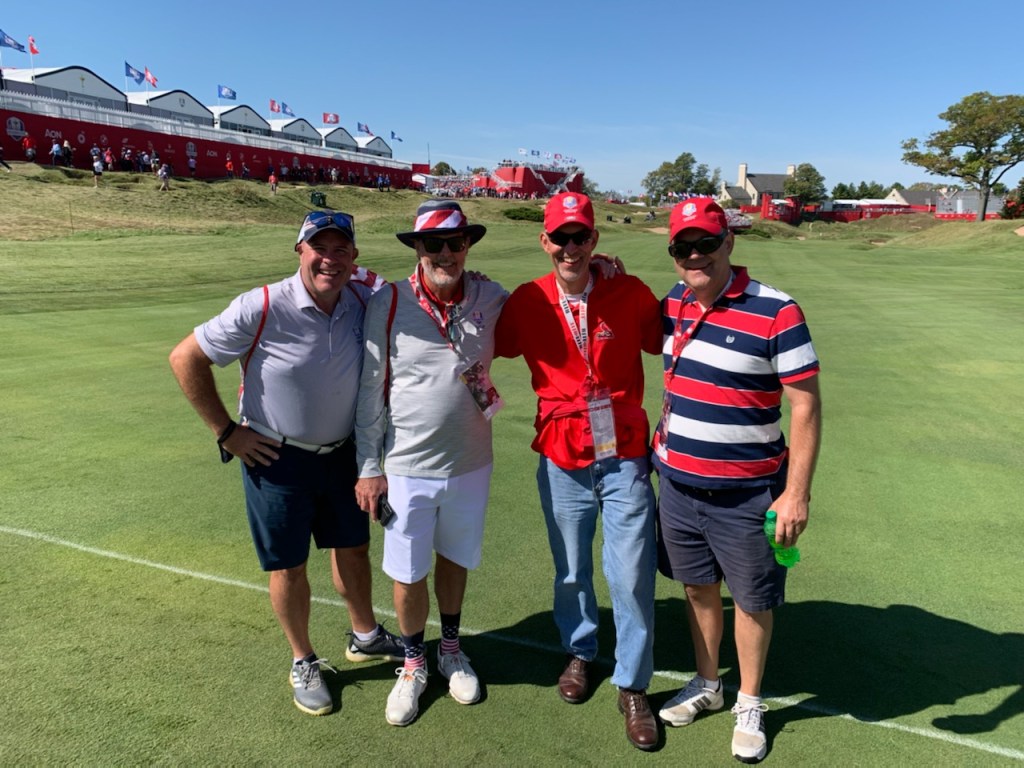
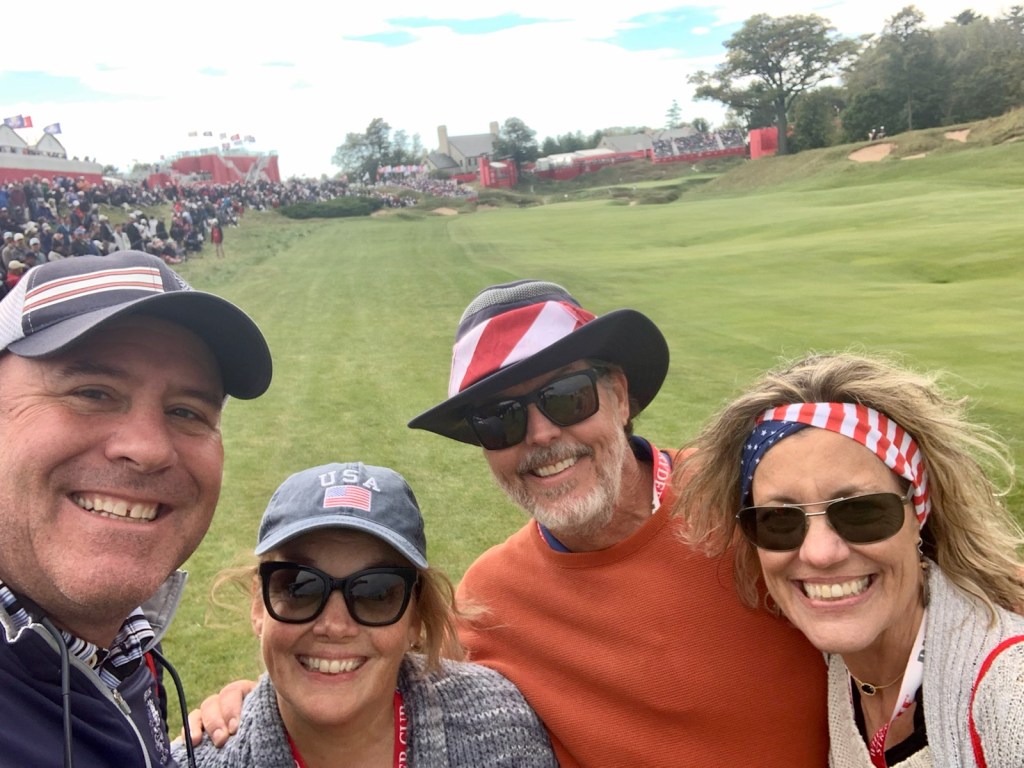
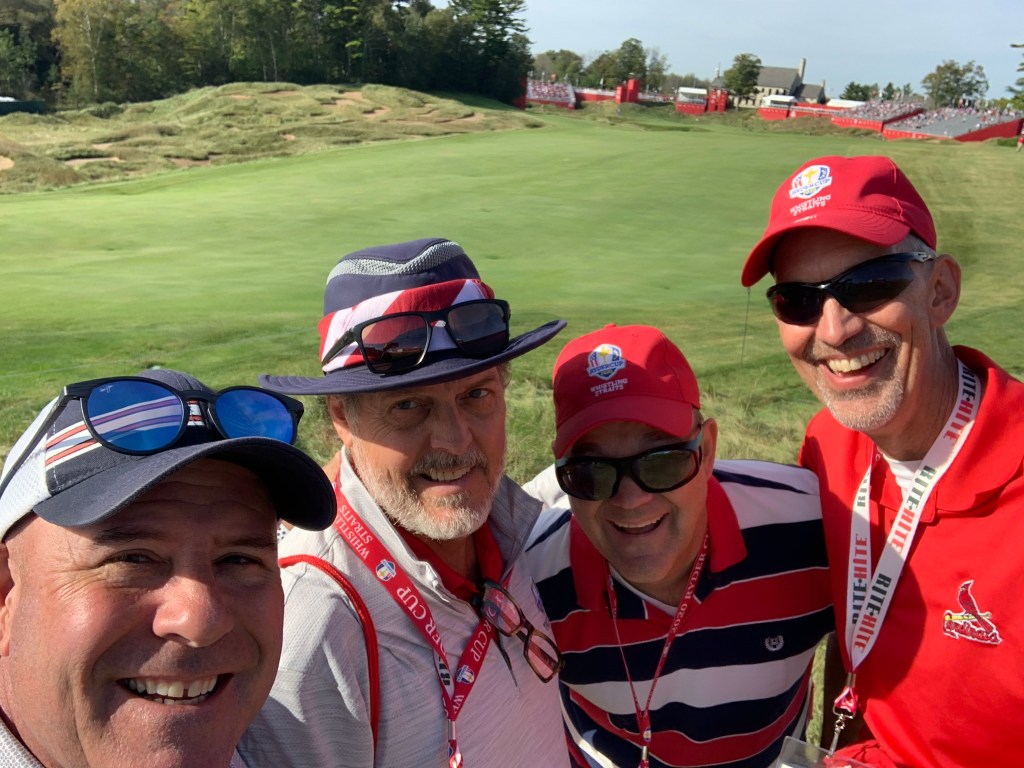
This is a good place to stop. Thanks again for joining me on the journey. See you out there. Fore ahead!
T. Carlos “Tim” Anderson – I’m a Protestant minister and Director of Austin City Lutherans (ACL), an organization of partners in Austin, Texas working together to serve low-income individuals and families.


 T. Carlos Anderson