Donald Trump rode down a golden escalator to the lobby of Trump Tower in Manhattan to announce his presidential candidacy in 2015. Denouncing Mexicans, he spoke of building a southern border wall that Mexico would pay for. He promised to be the “greatest jobs president,” making a direct connection between his self-proclaimed financial success and a future booming US economy.
Trump, of course, had toyed with the idea of running for president in prior election cycles. But in 2015, he boldly captured the nation’s attention as he confidently owned the crowded Republican primary debate stages. When Trump spoke, his growing numbers of adherents raised their eyebrows and nodded their heads in agreement. They laughed at the derogatory nicknames and barbs he flung at opponents. He found favor with those fed up with a growing elitism in the Democratic party, and his “America first” mantra made sense to workers and retirees who appreciated someone who promised to take on globalization and “Made in China.” Those who leaned conservative, including “soccer moms,” appreciated his proposed strategy to end legalized abortion by appointing conservative justices to the Supreme Court.
It all worked as he emerged from the large field of Republican candidates to take on the Democratic shoe-in primary candidate, Hillary Clinton. Just a few months before the election, Clinton’s description of Trump supporters as a “basket of deplorables” tilted momentum toward Trump. She was right to such describe a small section of Trump supporters—white supremacists—but the comment helped cement a shift of working-class voters to the Republican column.
A stunning victory—The New York Times infamously predicted on the eve of the election that Clinton had a 90 percent chance of victory—ushered in the Trump era.
I, like many, was shocked and dismayed. I couldn’t believe that our country had elected as president someone whom I considered to be a lying and narcissistic con-man.
The Saturday prior to the election, the Austin-American Statesman published an article I wrote entitled “In Lieu of Flowers.” What follows is the backstory.
In January 2016, my mom texted to me in Texas from the Land of Lincoln, where my siblings and I were raised. She informed me that the mother of one of my high school classmates had passed away. At that time, my high school graduation from a large Chicago suburban high school was more than thirty-five years past. I had played on the basketball team with a son of the deceased, but we had not been close and didn’t stay in touch beyond high school. As my mom and I continued to text back and forth, she further informed me that the woman’s obituary had an interesting closing request: In lieu of flowers, don’t vote for Hillary Clinton.
How about that for a twist on the obituary page? My eyes grew large, and I laughed in surprise upon reading my mom’s text report on the obit’s closing appeal.
Later that week, I did some quick research and discovered that, in obituary pages across the country, numerous similar requests in 2016 reached out to voters from the great beyond, or, at least, from the grave. And in an accurate reflection of unfavorable ratings polls, Clinton and Trump led the way with negative mentions on bereavement pages from New York to Honolulu.
Political partisanship, ascendent since the speakerships of Newt Gingrich and Nancy Pelosi, was becoming hyper-partisan as Trump and Clinton went at it. I questioned in the article: “Could the spirit of American hyper-partisanship be strong enough to survive into the great beyond, colonizing a few cloistered places for hyper-partisans?” Ha—as if the heavenly court of the Almighty would be properly divided with a fence running down its middle, Dems on the left and conservatives on the right. Shoot, make it a wall and have independents—the politically unaffiliated—pay for it.
I concluded by writing, that weekend before the fateful election: “Vote your conscience, love your neighbor and begin to shed any negative hyper-partisanship that unnecessarily discolors your relationships with others in the human family.”
Hmmm . . . that closing line could be categorized as “wishful thinking.” But—now—ten years later, this is more than Pollyanna admonition. It’s the voice of the people based upon the mid-term voting of November 2026. A voting majority of us are exhausted with Trump and tired of the hyper-partisan name-calling, finger-pointing, and spirit of zero cooperation across the political aisle. And we want some accountability in the face of rampant corruption. Trump was not going to and won’t ever change. So, something else had to change.
His base is yet fervent, but it is now stripped bare to minority numbers. A majority of us, as Trump asked, did “pretend [he] was on the ballot”—not as he intended, however—and his support is weakening. The votes are no longer there: fewer independents giving Trump the benefit of the doubt . . . fewer Hispanics, especially those of South Texas, joining in because of shared “conservative values” . . . and significantly fewer young Americans, many not able to afford home ownership, somehow hoping that Trump could Midas-touch the economy.
The end of this era is in sight because the people have spoken forcefully with their ballots. And this I write to you from the heart of Texas, where—incredibly—we elected Democrats to numerous statewide positions for the first time in more than thirty years. And beyond Texas, moderate candidates, focused on getting things done for their constituents, claimed victories for US Senate seats: Pastor Adam Hamilton, Roy Cooper, Josh Turek. A slew of “Blue Dog Dems”—center-left Democrats who’ve won US House seats in 2024 Trump-won districts—make for a long list. Some cynics say things won’t change. Au contraire—with the end of the Trump era in sight, things have already changed.
Now I Know Why People Clapped for the Sermon
In a blog post in 2018, I asked the question: “If Trump were alive in the pre-Civil War era, would he have been a slaveholder?” Undoubtedly so, yes. In 2019, the Statesman published an op-ed I wrote entitled “Words Create Worlds.” I wrote it in response to the horrific killing of twenty-two people (mostly Hispanic) at an El Paso Walmart by a young white Dallasite who was negatively charged by Trump’s words about the Mexican border—“invasion,” infestation,” “criminals.” The article’s title, based on Genesis 1, comes from the teaching of Rabbi Abraham Joshua Heschel, who marched alongside Martin Luther King, Jr. and other hundreds from Selma to Montgomery in 1965. The momentous sway of this march gave President Lyndon Johnson the political cover to arm-wrestle the passing of the Voting Rights Act. Heschel said the words of public leaders—for better or worse—create the contexts for common good or evil and violence.
Heschel knew exactly what he was talking about. Born in Poland in 1907, he taught at a Jewish seminary in Frankfurt, Germany in the 1930s. He eventually escaped to the US, but his mother and three of his sisters perished as Holocaust victims of the Nazis.
I gave a sermon at Shepherd of the Hills Lutheran Church in the Westlake community of Austin on February 15, 2026. As director of the nonprofit Austin City Lutherans (I call our organization the “other ACL,” which always draws a laugh), I visit our network congregations to share updates on our ministries. Shepherd of the Hills fervently supports and participates in ACL activities. It was Transfiguration Sunday with the gospel text of Matthew 17:1–9 and I focused on God’s words about Jesus that broke forth from the clouds: “Listen to him!” I took on Christian Nationalism and its desire to dominate society via conformity and control—the Texas legislature leading the nation in book banning, as an example—and called out (not by name) politicians who do the God-talk but by their policy actions make a mockery of what Jesus actually taught. Christian Nationalism, in its goal to create a “Godly” society, sidesteps the One who came to “show us the Father.”
People clapped at the sermon’s end. Perhaps they were happy it was over? Ha—that wasn’t it. Lutherans simply don’t clap for sermons. But after the elections of November 3, 2026, I better understand why they did clap that Sunday: It was a precursor of the election results. There’s a collective exhaustion and frustration with the Trump administration and its negative societal influences affecting ours and our neighbors’ daily lives. Christians are called to listen to Jesus who said, “Love your neighbor,” “Blessed are the peacemakers,” and “Forgive others as God has forgiven you.” He was the one who taught his hearers that the God of Israel calls his people to welcome the stranger, to share food with the hungry, to clothe the naked, and to walk alongside the sick, the outcast, the imprisoned. These are some of the things that Austin City Lutherans tries to do as a networked organization in service to neighbors in Austin who are struggling economically. If we want to have a more “Godly” society, we have to understand—contrary to the teachings of Christian Nationalism—that the things Jesus taught are more than individual mandates. “Loving your neighbor” can be constructed by government policy.
A number of “Christian Left” leaders were elected in November to national offices—the aforementioned Pastor Hamiliton; James Talarico, a Presbyterian seminarian; Lutheran pastor Sarah Trone Garriot; and others. The days of politically conservative Christian pastors solely speaking for God in the political realm are officially over. There are other perspectives, other voices. There are issues other than abortion.
Thankfully, the end of the Trump era is in sight because the voters have spoken. Enough already of the purposeful divisiveness, the incompetency of leadership due to presidential appointments based solely upon personal loyalty, and the shameful presidential pardons for sale. Enough also of the full embrace of lying as a political modus operandi, and the spinelessness of the president’s own party that has resulted in zero accountability from the Oval Office. And certainly enough of the president’s fascination and wannabe-ism with authoritarian leaders.
I, for one, am relieved. And encouraged. May we go forward with an old but still enlightening idea: E pluribus unum—out of many, one.
T. Carlos “Tim” Anderson – I’m a Protestant minister and Director of Austin City Lutherans (ACL), an organization of partners in Austin, Texas working together to serve low-income individuals and families.
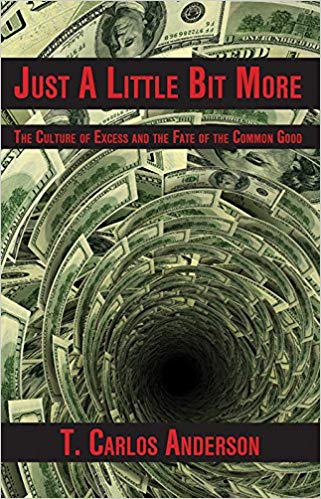


Check out any of my books – Just a Little Bit More (2014), There is a Balm in Huntsville (2019), and There is a Balm in Wichita Falls (2024).


